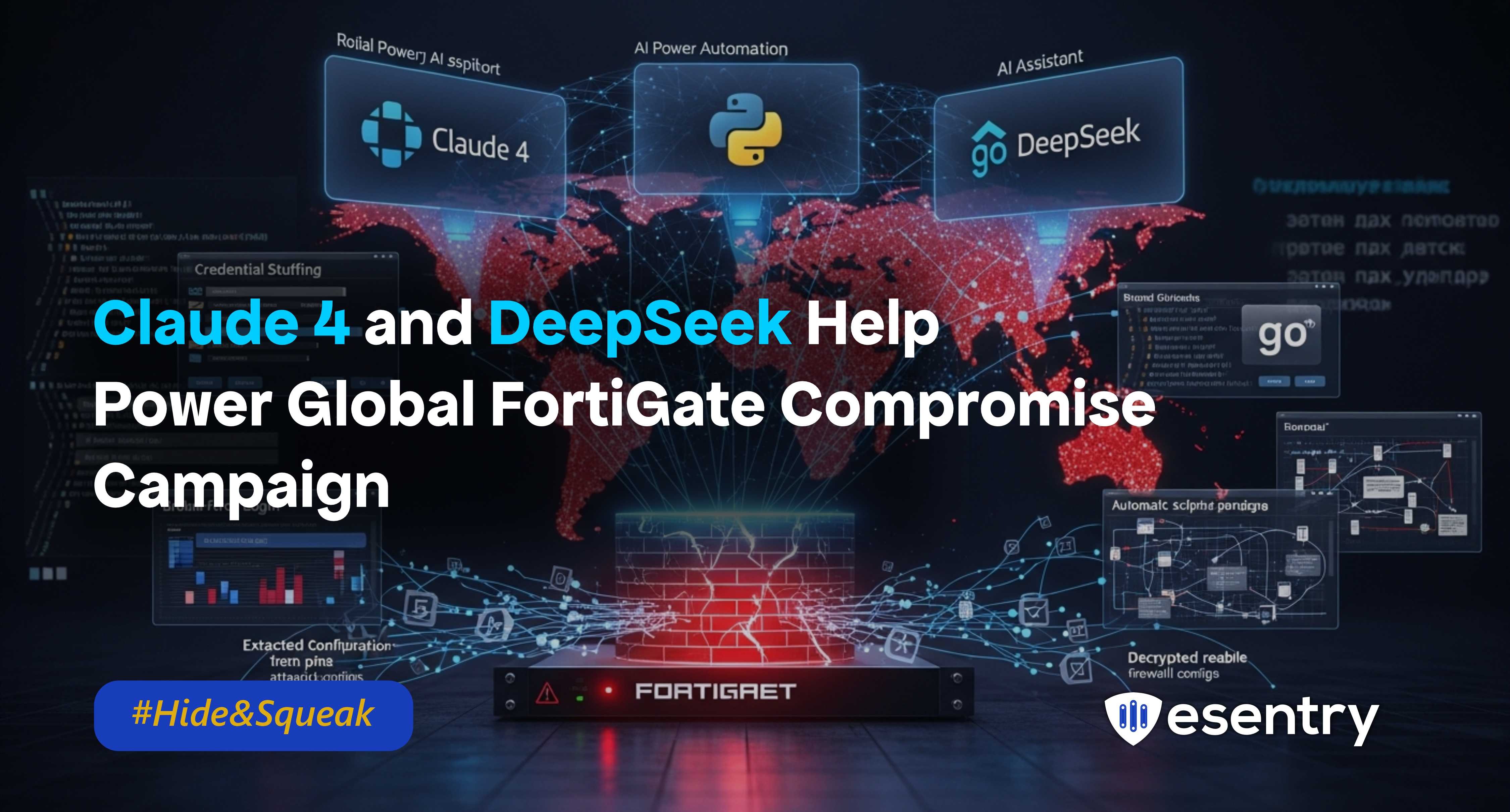
Between January and February 2026, a financially motivated threat actor used commercial generative AI, includingClaude 4 and DeepSeek, to compromise more than 600 Fortinet FortiGate devices across over 55 countries.
This campaign was not driven by zero days or sophisticated exploits. It demonstrated the industrialization of low complexity attacks powered by AI assistance.
By combining exposed management interfaces, weak credentials, and AI generated automation, the actor achieved a level of scale that previously required a more capable intrusion team.
How Intrusions Happened
The operation began with broad internet scanning for publicly exposed FortiGate management interfaces, particularly on common HTTPS management ports.
Once targets were identified, the actor launched credential stuffing and brute force attempts against administrative and SSL VPN portals. Where access succeeded, full configuration files were exfiltrated.
These files are highly sensitive becausethey often contain recoverable VPN credentials, administrative accounts, network topology, firewall rules, and IPsec peer details, effectively providing a blueprint of the internal environment.
To accelerate exploitation, the actor used AI assisted scripting to automatically parse and decrypt the stolen configurations, converting raw data into immediately actionable intelligence.
Where Claude 4 and DeepSeek Came In
Analysis shows the actor used generative AI repeatedly across the intrusion lifecycle, not to invent new techniques but to compress the skill and time required to execute them.
AI was used to:
• Design step by step intrusion workflows
• Generate credential attack strategies
• Produce Python and Go automation scripts
• Build configuration parsers
• Troubleshoot operational issues
• Provide post access attack guidance
In effect, AI operated as an on demandtechnical copilot, enabling a relatively unsophisticated actor to move fasterand more systematically.
Actor Assessment
Indicators suggest a financially motivated operator, likely an individual or very small group with moderate technical depth but heavy reliance on AI assistance. Russian language artifacts were observed in operational materials.
When exploitation attempts failed against properly hardened environments, the actor did not significantly adapt. Instead,they moved on to easier targets.
The campaign clearly favored volume and automation over sophistication.
Why This Matters Now
The barrier to entry for meaningful cyberintrusion continues to fall.
Generative AI is not replacing advanced threat actors, but it is significantly amplifying lower tier operators. Tasks that once required specialized scripting, research time, or deeper expertise can now be generated and refined in minutes.
For defenders, this means more scale, morenoise, and more opportunistic campaigns that appear structured even when theyare not.
Organizations that still rely on basic perimeter assumptions are increasingly exposed.
Defensive Focus Areas
Security teams should closely monitor for:
• Repeated authentication attempts against FortiGate management interfaces
• Administrative access from anomalous geographies
• Unexpected configuration backup activity
• Signs of credential harvesting or NTLM extraction
• Active Directory replication abuse, including DCSync patterns
• Unusual access to backup infrastructure
Recommended Actions
Immediate risk reduction should focus on fundamentals:
• Remove public exposure of FortiGate management interfaces
• Enforce MFA for all administrative and SSL VPN access
• Rotate and harden credentials, eliminating reuse
• Maintain current FortiGate patch levels and hardening baselines
• Monitor aggressively for brute force and configuration access activity
• Segment management planes and apply least privilege controls

.jpeg)
.jpeg)
.jpeg)

.png)


.png)
.png)