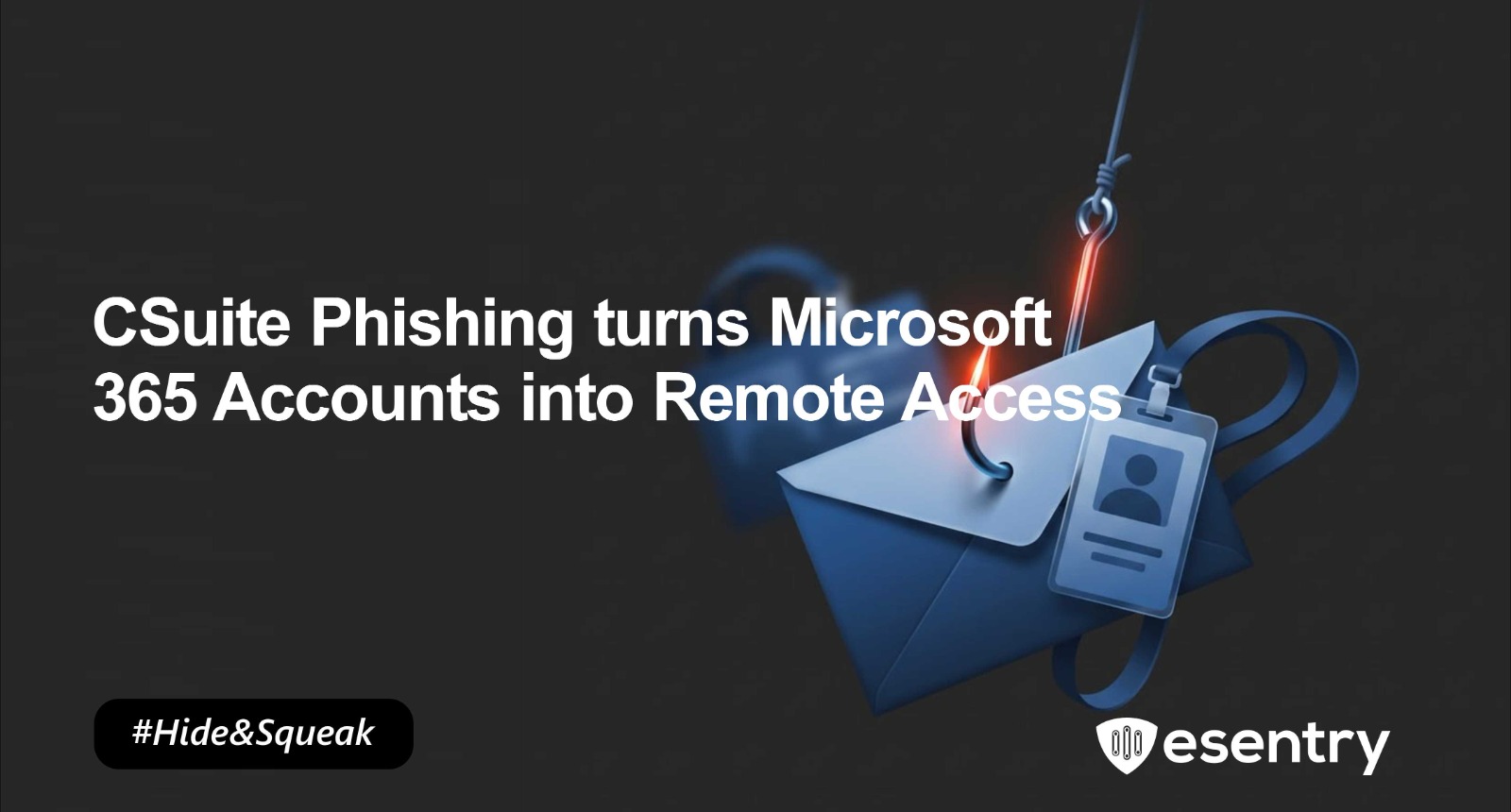
Phishing attacks have moved beyond simply stealing usernames and passwords. The CSuite campaign shows how attackers can combine Microsoft 365 session theft with legitimate remote-management software to gain access to both an employee's digital identity and endpoint.
According to research, the operation was linked to 351 sandbox analyses across 170 hosts, with 51% of the observed submissions coming from the United States. The campaign has also been observed across other countries and uses business-themed lures involving services such as Adobe, DocuSign, Zoom, Dropbox, SharePoint and Microsoft 365.
For financial institutions, the concern goes beyond email compromise. A compromised executive or employee account can provide access to sensitive correspondence, customer information, financial documents, payment workflows and trusted internal communication.

How the Attack Starts
CSuite uses something employees interact with every day: business documents and notifications. Victims may receive messages appearing to come from familiar services such as Adobe, DocuSign, Zoom or Microsoft 365. The message typically creates a reason to open or review a document.
The victim is then directed through a series of pages designed to look legitimate. Some paths lead to a fake document viewer, while others lead to Microsoft 365 credential or device-code phishing pages.
The goal is simple: Get the victim to trust the workflow before asking for access.
The Dangerous Part: Stealing the Session
CSuite does not always need to steal a password and break through MFA afterwards. One of its attack paths uses device-code authentication to trick victims into completing a legitimate Microsoft authentication process for the attacker.
In another path, credentials and an authenticated Microsoft 365 session are captured and passed back to the attackers.
Then Comes the Remote Access
The campaign does not stop at Microsoft 365. CSuite also delivers legitimate remote-management and endpoint-management tools, including ScreenConnect, Action1, Atera, Syncro and PDQ Connect. These tools are normally used by IT teams to remotely manage computers, which makes their presence less suspicious than an unknown remote-access program.
Attackers can rename or disguise these tools as familiar business applications such as Adobe or DocuSign and use them to establish remote access to the victim's computer.
Why this Matters to Financial Institutions
For a bank, fintech or other financial organization, the compromised account may be more valuable than the employee's device itself.
An executive or finance employee's mailbox can contain:
- Payment instructions and approvals
- Customer and vendor correspondence
- Financial statements and documents
- Internal reports
- Authentication and account-recovery information
- Conversations involving sensitive transactions
An attacker controlling that mailbox can also use the employee's trusted identity to send convincing messages to colleagues, vendors or customers. That creates a path from phishing to account takeover to trusted communication and finally to financial fraud.
The CSuite campaign therefore highlights a risk that financial institutions should take seriously: the attacker does not always need to look like an attacker. A legitimate Microsoft 365 session and a legitimate remote-management tool can both be used as part of the intrusion.
Recommendations
- Monitor Microsoft 365 activity: Detect unusual sessions, device-code authentication, new devices and suspicious account activity.
- Monitor RMM tools: Track ScreenConnect, Action1, Atera, Syncro and other remote-management tools across endpoints.
- Control remote-access software: Allow only approved RMM applications and alert on unauthorized installations.
- Correlate identity and endpoint events: Link suspicious Microsoft 365 logins with new processes, downloads and remote-access activity.
- Strengthen phishing detection: Monitor document-sharing lures, impersonation attempts, suspicious URLs and authentication-themed phishing.
- Respond to session theft: Revoke active sessions and tokens, reset affected credentials and review authentication and mailbox activity.
- Investigate compromised endpoints: Isolate affected devices and check for unauthorized RMM tools, persistence and further access.
Visibility is what connects the first suspicious login to the activity that follows. Our threat intelligence, endpoint monitoring, detection and incident response capabilities help security teams identify these patterns, investigate compromised accounts and endpoints, and contain threats before they escalate.