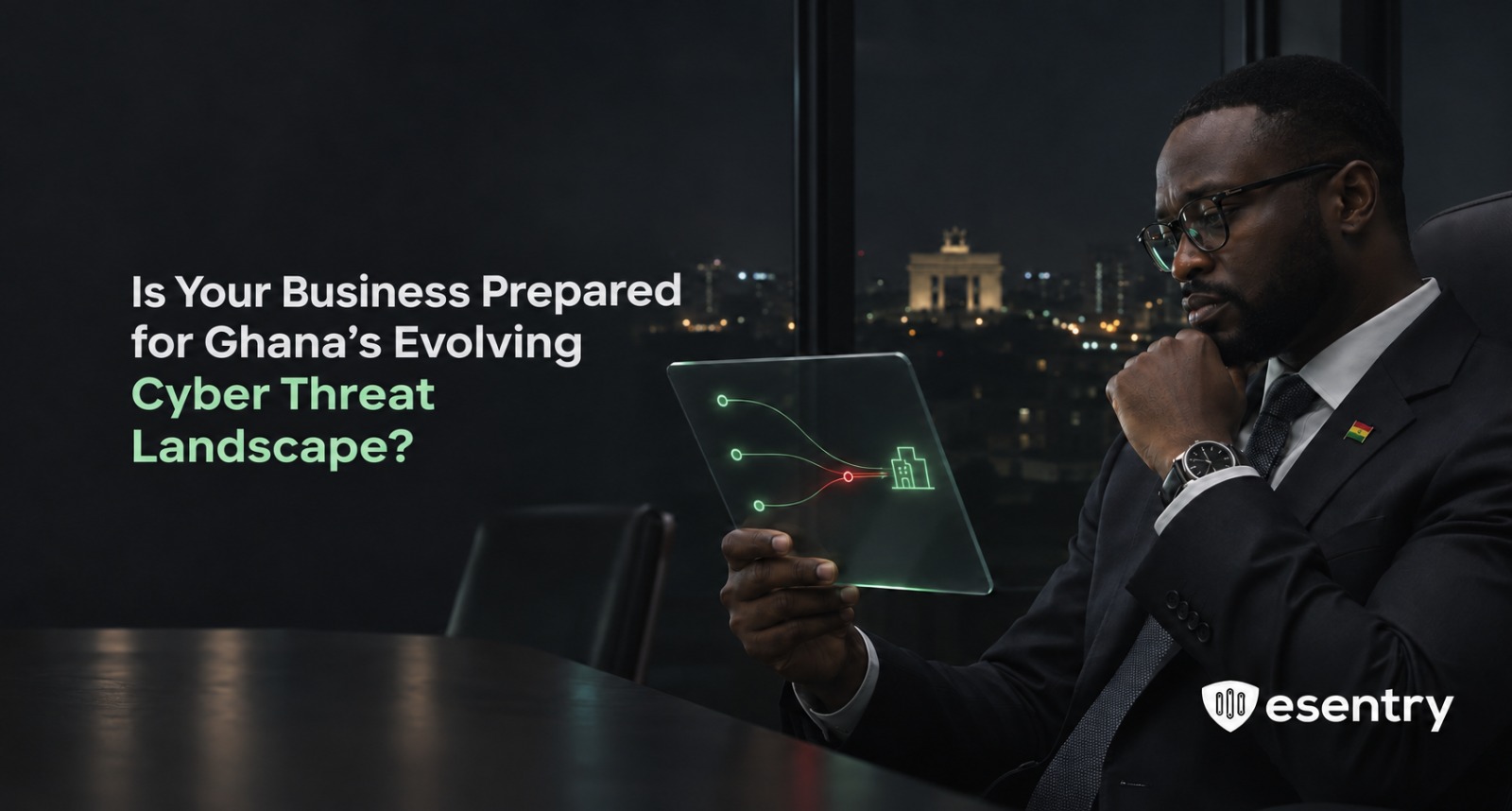
Ghana's digital economy continues to create new opportunities for businesses.
From mobile money and digital banking to e-commerce, cloud-based operations, and connected business applications, organisations are increasingly relying on technology to serve customers, improve efficiency, and drive growth.
But as businesses become more connected, they also become more exposed.
Imagine arriving at work to discover that your organisation's critical systems are inaccessible. Or receiving a call from your finance department because a payment intended for a trusted supplier was redirected to a fraudulent account.
Perhaps an employee's compromised credentials have given an attacker access to sensitive customer information.
These are not simply IT problems. They are business disruptions that can affect revenue, operations, customer confidence, and organisational reputation.
And recent developments in Ghana's cybersecurity landscape show why these risks deserve serious attention.
The question is no longer whether cybersecurity matters to your business. It is whether your organisation is adequately prepared for the threats it faces.
Ghana's Cyber Threat Landscape: What the Numbers Tell Us
The financial consequences of cybercrime in Ghana are becoming increasingly significant.
According to figures disclosed by Ghana's Cyber Security Authority (CSA), the country recorded 4,938 reported cybersecurity incidents between January and September 2026, resulting in estimated financial losses exceeding GH¢209.7 million.
For comparison, the Authority recorded 4,604 incidents and reported financial losses exceeding GH¢22.5 million throughout 2025.
This means that reported financial losses in the first nine months of 2026 were more than nine times the figure recorded for the entire previous year.
Online fraud remained the leading reported category, accounting for approximately 48% of incidents recorded between January and September 2026.
These figures reflect incidents reported to the Authority, rather than the complete scale of cybercrime across the country. They also include incidents affecting individuals and institutions, so they should not be interpreted as business-only losses.
Nevertheless, they provide an important indication of Ghana's changing threat environment.
For businesses, the implications are clear.
As financial transactions, customer interactions, and operational processes increasingly move online, organisations need to strengthen their ability to prevent, detect, and respond to cyber threats.
Cybersecurity can no longer be treated as an occasional technical concern. It needs to become part of everyday business risk management.
The Cyber Threats Ghanaian Businesses Cannot Afford to Ignore
Although cyber threats vary across industries, several attack methods present significant risks to organisations operating in Ghana.
1. Business Email Compromise and Financial Fraud
Business email compromise (BEC) is particularly concerning for organisations that rely on email to communicate with suppliers, approve payments, or manage financial transactions.
Attackers may compromise a legitimate business email account or impersonate a trusted executive, supplier, or business partner.
They can then send fraudulent payment instructions, request sensitive financial information, or manipulate employees into transferring money.
For example, an accounts officer might receive an email appearing to come from a familiar supplier, requesting that an outstanding invoice be paid into a newly provided bank account.
Without an established verification process, the organisation could unknowingly transfer funds to an attacker.
What businesses should do: Introduce independent verification for changes to payment details, enforce multifactor authentication on business email accounts, and train employees to recognise suspicious financial requests.
2. Phishing and Credential Theft
Phishing remains a common method attackers use to gain unauthorised access to business systems.
Employees may receive fraudulent emails, messages, or links designed to steal passwords, capture sensitive information, or install malicious software.
As attackers adopt increasingly convincing impersonation techniques, identifying fraudulent communications can become more difficult.
A single compromised employee account may provide access to internal applications, confidential documents, customer information, or connected business systems.
What businesses should do: Strengthen identity and access controls, enable multifactor authentication, deploy appropriate email protection, and conduct regular employee security awareness training.
3. Ransomware and Operational Disruption
Ransomware attacks can encrypt files, interrupt business operations, and prevent organisations from accessing essential systems.
Some attackers also steal sensitive information and threaten to disclose it unless their demands are met.
For businesses that depend on digital platforms for daily operations, the consequences can extend beyond the initial compromise.
An attack may disrupt service delivery, delay financial transactions, affect customers, and create significant recovery expenses.
What businesses should do: Maintain tested and appropriately protected backups, address critical vulnerabilities, strengthen endpoint security, and establish an incident response plan.
4. Vulnerabilities in Business Applications and Cloud Environments
As organisations adopt cloud services, web applications, and interconnected platforms, their technology environments become more complex.
Misconfigured cloud resources, outdated software, insecure applications, and poorly managed access permissions can create opportunities for attackers.
These weaknesses may expose sensitive business information or allow unauthorised access to critical systems.
For organisations undergoing digital transformation, security needs to be considered throughout the deployment and management of technology.
What businesses should do: Conduct regular vulnerability assessments and penetration testing, maintain secure configurations, review access permissions, and monitor critical systems for suspicious activity.
5. AI-Enabled Fraud and Impersonation
Artificial intelligence is creating opportunities for businesses, but it is also providing cybercriminals with new ways to improve their attacks.
AI-generated messages, synthetic voices, and manipulated videos can make impersonation attempts more convincing.
An employee may receive what appears to be an urgent instruction from a senior executive or trusted partner, even though the communication was generated or manipulated by an attacker.
For businesses, this reinforces the need for reliable verification procedures.
What businesses should do: Establish independent approval processes for sensitive transactions, educate employees about AI-enabled impersonation, and avoid relying solely on voice, video, or email identity when authorising high-risk actions.
The Real Cost of a Cyber Incident Goes Beyond Financial Loss
When organisations assess cyber risks, attention often focuses on the immediate financial consequences of an attack.
However, the broader business impact can be equally significant.
Operational downtime: An incident affecting critical systems may prevent employees from delivering services, processing transactions, or accessing essential business information.
Customer trust: A security breach involving sensitive information can undermine customer confidence and damage established business relationships.
Regulatory and legal exposure: Depending on the nature of the incident and the organisation's obligations, a breach may create reporting requirements, investigations, contractual consequences, or other compliance concerns.
Recovery expenses: Investigating an incident, restoring systems, engaging specialist support, and implementing corrective measures can create substantial unplanned costs.
Business growth: A major security incident may delay expansion plans, interrupt strategic projects, and redirect resources away from planned investments.
This is why cybersecurity should not be measured solely by the cost of security technologies.
It should also be evaluated by the business disruption, financial exposure, and operational risks those investments help reduce.
How Prepared Is Your Business? Five Questions to Ask
Understanding the threat landscape is important. But awareness alone does not make an organisation secure.
Business leaders need to understand whether their existing security measures can address the risks most relevant to their operations.
The following questions provide a practical starting point.
1. Do You Know Your Organisation's Most Critical Cyber Risks?
Every organisation has systems, information, and processes that are essential to its operations.
These may include financial platforms, customer databases, cloud applications, business email accounts, and operational infrastructure.
Have you identified which of these assets are most critical and what could happen if they were compromised?
Without this understanding, security investments may not address the risks with the greatest potential business impact.
2. When Was Your Last Security Assessment?
Technology environments change as organisations introduce new applications, onboard employees, expand operations, and integrate third-party systems.
Security weaknesses can emerge even in environments that were previously considered secure.
Regular vulnerability assessments, penetration testing, and security reviews help organisations identify potential weaknesses before attackers exploit them.
If your organisation has never conducted a formal security assessment, that is an important place to begin.
3. Can You Detect Suspicious Activity Across Your Systems?
Preventive security measures are essential, but they cannot eliminate every threat.
Organisations also need the ability to identify unusual activity, investigate potential compromises, and respond before incidents escalate.
Ask yourself:
If an attacker gained access to a critical system today, how quickly would your organisation know?
Without adequate monitoring and detection capabilities, malicious activity may remain unnoticed until significant damage has occurred.
4. Does Your Organisation Have an Incident Response Plan?
When a security incident occurs, uncertainty can make the situation worse.
Employees may not know who to contact, which systems to isolate, how to preserve evidence, or what information should be communicated to stakeholders.
An incident response plan establishes clear responsibilities and procedures for managing security events.
However, having a document is not enough.
The plan should be reviewed, tested, and updated to reflect the organisation's actual operating environment.
5. Can Your Business Recover From a Major Cyber Incident?
Even organisations with strong preventive controls must prepare for the possibility of disruption.
Do you maintain reliable backups of critical information?
Have you tested your ability to restore essential systems?
Do you know which business processes must be recovered first?
Business continuity and disaster recovery planning help organisations reduce the operational impact of incidents and restore essential services more effectively.
If your organisation cannot confidently answer these five questions, it may be time to review your cybersecurity readiness.
What Ghana's Cybersecurity Regulatory Environment Means for Businesses
Ghana has taken steps to strengthen cybersecurity governance and oversight through the Cybersecurity Act, 2020 (Act 1038).
The Act established the Cyber Security Authority, which is responsible for regulating cybersecurity activities and supporting the development of Ghana's cybersecurity ecosystem.
Among its responsibilities is the licensing of Cybersecurity Service Providers and the accreditation of relevant cybersecurity establishments and professionals.
The licensing regime covers service areas including vulnerability assessment and penetration testing, digital forensics, managed cybersecurity services, cybersecurity governance, risk and compliance, and cybersecurity training.
For organisations seeking external cybersecurity support, this provides an important consideration when selecting a service provider.
Businesses should verify that providers hold the appropriate regulatory authorisation for the services they offer.
Organisations must also understand the cybersecurity, data protection, and sector-specific obligations applicable to their own activities.
Regulatory requirements differ according to the nature of the business, the information it processes, and the sector in which it operates.
However, compliance should not be the only objective.
The broader goal is to establish security practices that protect business operations, customer information, and organisational resilience.
Building a Stronger Cybersecurity Posture: Where Should Your Business Start?
Improving cybersecurity readiness does not necessarily require an organisation to implement every available security technology.
A more effective approach begins with understanding its current exposure and prioritising the measures that address its most significant risks.
Start With a Cybersecurity Assessment
Evaluate your organisation's critical assets, existing controls, vulnerabilities, and potential threat exposure.
This provides a clearer understanding of where improvements are needed.
Strengthen Your Security Foundations
Address weaknesses in access management, authentication, software updates, system configurations, and employee awareness.
These foundational measures can reduce exposure to common attack methods.
Establish Effective Threat Monitoring
Ensure your organisation has appropriate visibility into critical systems and the ability to investigate suspicious activities.
Depending on your operational requirements, this may involve internal security personnel, managed monitoring services, or a combination of both.
Prepare for Incidents Before They Occur
Develop and test incident response procedures.
Ensure employees understand their responsibilities and that the organisation has access to the expertise required to investigate, contain, and recover from security incidents.
Review Your Security Posture Regularly
Cybersecurity is not a one-time project.
As your organisation grows and adopts new technologies, its risks will change.
Periodic assessments and continuous improvement help ensure that security measures remain aligned with business needs.
How esentry Is Supporting Cybersecurity Readiness in Ghana
As Ghana's digital economy continues to develop, businesses need cybersecurity partners that understand both the technical challenges and the operational realities of protecting modern organisations.
At esentry, we are committed to helping organisations across Africa strengthen their cybersecurity posture and build resilience against evolving threats.
Our licensing by Ghana's Cyber Security Authority as a Cybersecurity Service Provider reinforces our commitment to delivering cybersecurity services within the country's regulatory framework.
Through our capabilities in Threat Intelligence, Cyber Offense & Security Testing, Security Engineering, 24/7 Security Operations Centre (SOC), Digital Forensics & Incident Response, AI Security, and vCISO services, we help organisations identify security gaps, strengthen protection, improve threat visibility, and prepare for cyber incidents.
Whether your organisation is seeking to understand its current exposure, improve security monitoring, or establish a more comprehensive cybersecurity strategy, our team can help you determine the next steps.
Our approach begins with understanding your business, the systems you depend on, and the risks that could affect your operations.
Cybersecurity Readiness Is Business Readiness
Ghana's growing digital economy presents significant opportunities for businesses to innovate, expand, and serve customers more effectively.
But the same technologies enabling that growth also create risks that organisations must understand and manage.
The cybercrime figures reported in 2026 reinforce the importance of proactive security measures.
Businesses cannot afford to wait until a major incident exposes weaknesses in their systems, processes, or response capabilities.
By assessing risks, strengthening security controls, improving threat detection, and preparing for incidents, organisations can take meaningful steps towards protecting their operations and building long-term resilience.
The question is not simply whether your business uses technology. It is whether your business is prepared to protect the technology it depends on.
How Prepared Is Your Organisation?
Understanding your cybersecurity risks is the first step towards strengthening your defences.
At esentry we help organisations assess their security posture, identify vulnerabilities, and develop practical strategies for managing cyber risks.
Contact us at services@esentry.io to discuss your organisation's cybersecurity readiness and explore how we can help you strengthen your security posture.