Overview
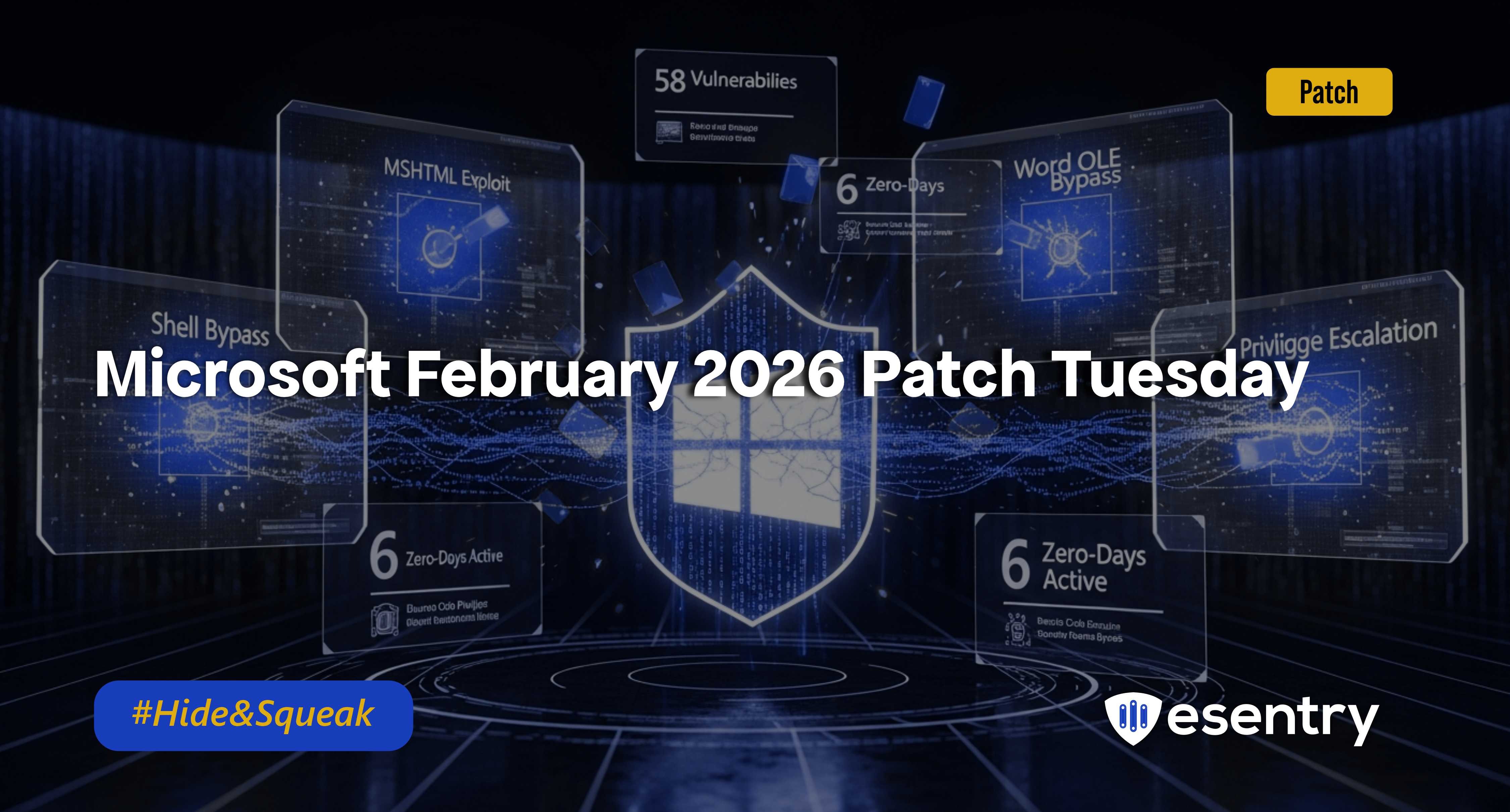
Microsoft has released this month’s Patch Tuesday, covering security updates for 58 vulnerabilities across Windows, Office, Azure and other core products. Importantly, this cycle contains six zero-day vulnerabilities that are actively exploited in the wild, and five critical-rated flaws that could enable serious system compromise if left unpatched. The vulnerabilities are listed below:
25 Elevation of Privilege
5 Security Feature Bypass
12 Remote Code Execution
6 Information Disclosure
3 Denial of Service
7 Spoofing
Actively Exploited Vulnerability
Out of the 6 actively exploited vulnerability, 3 of them (CVE-2026-21513, CVE-2026-21510, and CVE-2026-21514), has been publicly disclosed before the patch thereby increasing the risk of exploitation in unpatched environments. They include:
CVE-2026-21510 – Windows Shell Security Feature Bypass
Attackers can trick a user into opening a crafted shortcut or link file, allowing malicious content to run without SmartScreen or other user prompts.
CVE-2026-21513 – MSHTML Security Feature Bypass
A flaw in the MSHTML engine lets attackers bypass security protections over a network, enabling exploit chains involving HTML or shortcut content.
CVE-2026-21514 – Microsoft Word Security Feature Bypass
Malicious Office documents can bypass OLE mitigations, leading to execution of unsafe content when opened by a user.
CVE-2026-21519 – Desktop Window Manager Elevation of Privilege
Local attackers could elevate privileges to SYSTEM by exploiting issues in the Desktop Window Manager.
CVE-2026-21525 – Windows Remote Access Connection Manager DoS
Null pointer dereference may allow denial-of-service conditions on targeted machines.
CVE-2026-21533 – Windows Remote Desktop Services Elevation of Privilege
Improper privilege management in RDS enables attackers to gain higher privileges locally.
Recommendations
- Deploy patches immediately across all affected systems, starting with Windows hosts, Office installations, and Remote Desktop Services.
- Focus on user-facing endpoints and servers that process untrusted input (e.g., email attachments, web content).
- Confirm that systems handling Office documents and Windows Shell components are patched to mitigate the security feature bypass issues.
- Use centralized patch management to roll updates efficiently.
Validate patch deployment success and monitor for failed installs or reboot requirements.


.jpeg)
.jpeg)

.png)


.png)
.png)