
Overview
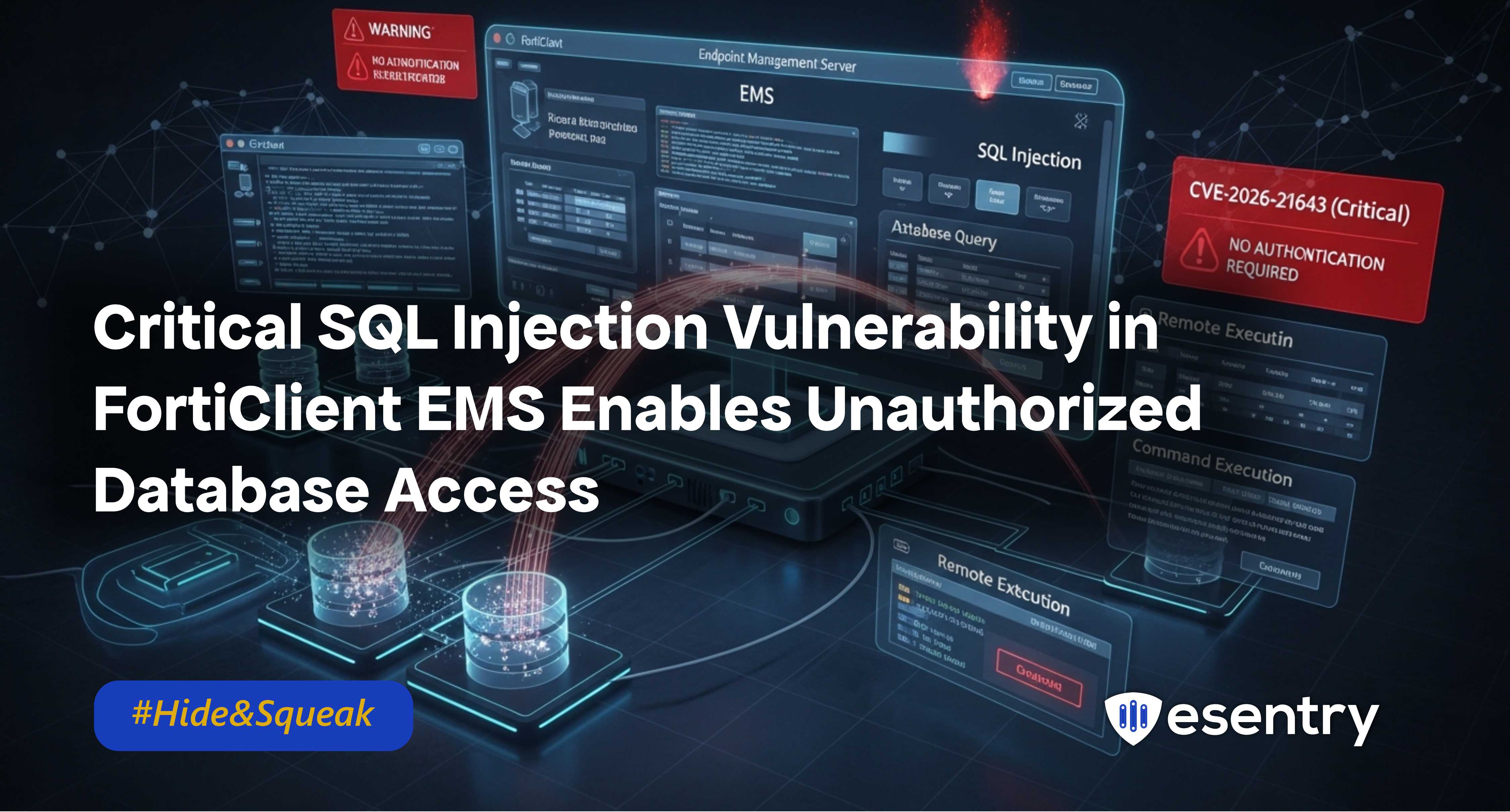
A critical SQL injection vulnerability has been identified in FortiClient Endpoint Management Server (EMS), a centralized management platform used to administer endpoints running FortiClient.
Tracked as CVE-2026-21643, the flaw allows attackers to execute unauthorized SQL commands against the FortiClient EMS database through specially crafted requests. The vulnerability which carries a CVSS score of 9.1, indicates critical severity due to its potential to allow remote exploitation without authentication.
If successfully exploited, attackers may gain unauthorized access to sensitive data, manipulate database records, escalate privileges, and potentially execute arbitrary code on the underlying server hosting FortiClient EMS.
Affected Products
The vulnerability affects FortiClient Endpoint Management Server version 7.4.4.
Fortinet has addressed the vulnerability in later versions and recommends upgrading to EMS version 7.4.5 or newer to remediate the issue.
Technical Details
The vulnerability stems from improper neutralization of special elements within SQL commands, a classic SQL injection flaw (CWE-89).
Within the EMS administrative web interface, user-supplied input is insufficiently sanitized before being passed to backend database queries. As a result, an attacker can inject malicious SQL statements through specially crafted HTTP requests sent to the EMS web interface.
Because the attack vector is network-based and does not require authentication or user interaction, a remote attacker can directly interact with the vulnerable interface to manipulate database queries.
The vulnerability’s CVSS vector (AV:N/AC:L/PR:N/UI:N/S:U/C:H/I:H/A:H) highlights the severity of the flaw:
- Network accessible
- Low attack complexity
- No privileges required
- No user interaction needed
These characteristics make the vulnerability highly exploitable and capable of leading to full system compromise.
Potential Impact
Successful exploitation of CVE-2026-21643 may allow attackers to perform several malicious actions within affected environments such as:
- Unauthorized access to the EMS database
- Extraction of sensitive organizational or endpoint data
- Manipulation or deletion of database records
- Privilege escalation within the EMS platform
- Deployment of malicious commands on the server
- Remote code execution on the host system
- Compromise of managed endpoints through altered security policies
Because FortiClient Endpoint Management Server acts as a central control system for endpoint security, compromising it can provide attackers with visibility into the organization’s network and the ability to manipulate security configurations across multiple endpoints.
Why This Vulnerability Is Dangerous
- Unauthenticated exploitation: Attackers can exploit the flaw without valid credentials.
- Direct database manipulation: SQL injection allows attackers to read, modify, or delete database records.
- Potential remote code execution: Database manipulation may lead to execution of arbitrary commands on the EMS server.
- Centralized management compromise: Since EMS manages multiple endpoints, a single compromise can affect an entire environment.
- Low attack complexity: Exploitation requires only specially crafted HTTP requests.
- High impact on confidentiality, integrity, and availability: Attackers could access sensitive data, alter system configurations, or disrupt services.
Mitigation and Recommendations
Organizations using FortiClient Endpoint Management Server should take the following steps immediately:
1. Apply security updates: Upgrade to FortiClient EMS version 7.4.5 or later, which includes the fix for this vulnerability.
2. Restrict access to the EMS interface: Limit access to the EMS administrative interface using network segmentation, firewall rules, or VPN access.
3. Monitor for suspicious activity: Review system and web server logs for unusual HTTP requests targeting the EMS interface.
4. Conduct vulnerability scans: Use security scanning tools capable of identifying vulnerable EMS versions within the environment.
5. Harden management servers: Ensure that EMS servers are isolated from publicly exposed networks and enforce strict access control policies.
Conclusion
The discovery of CVE-2026-21643 highlights a serious security risk for organizations relying on FortiClient Endpoint Management Server to manage their endpoint security infrastructure.
Given its ability to allow unauthenticated attackers to manipulate database queries and potentially execute arbitrary code, unpatched systems may face complete compromise. Organizations should prioritize immediate patching and implement additional access controls to reduce the risk of exploitation.



.jpeg)

.png)


.png)
.png)