
Overview
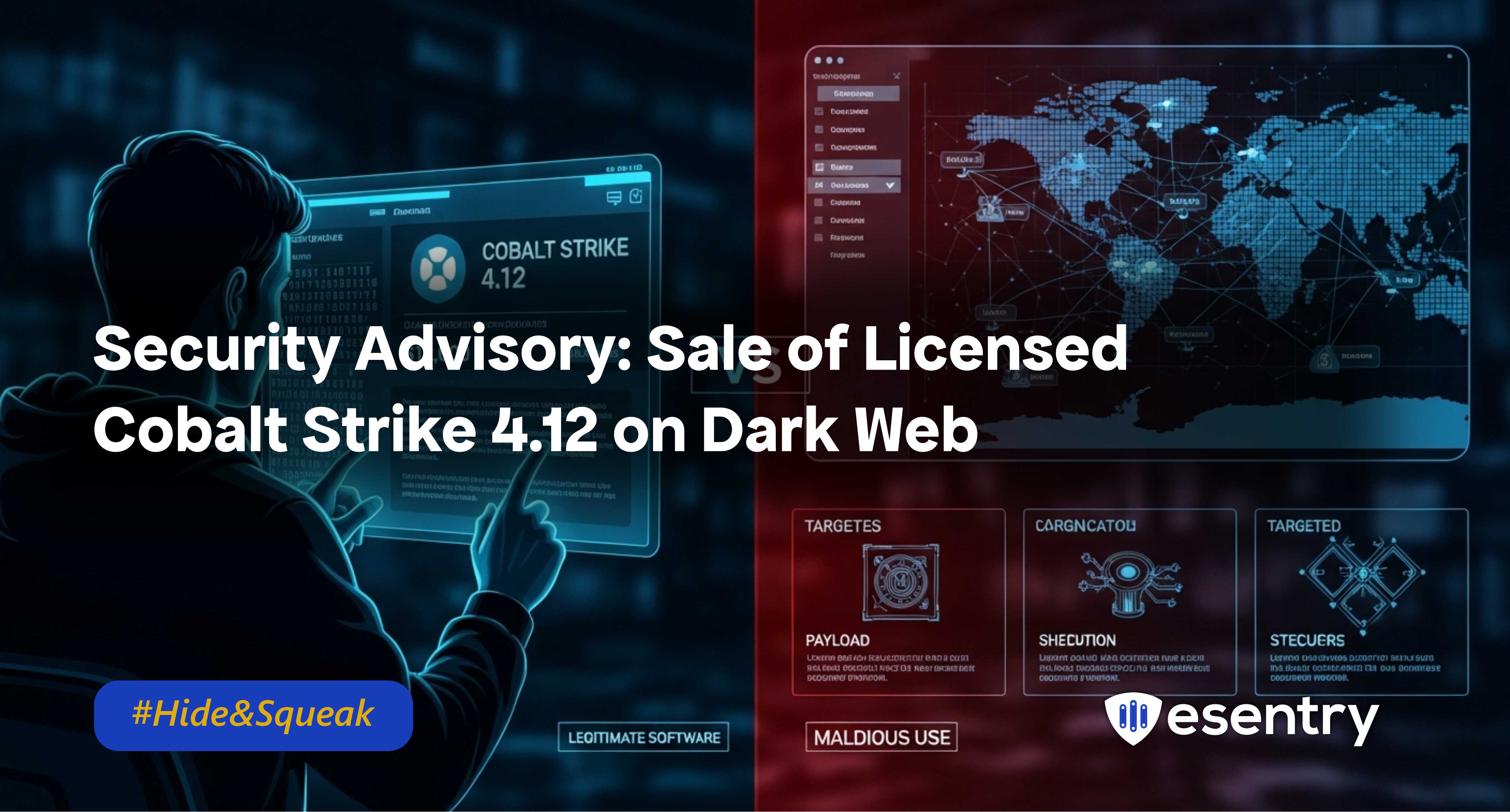
Recent dark web intelligence indicates a legitimate and licensed version of Cobalt Strike 4.12 is being offered for sale on a hacker forum for approximately $12,000. Notably, the package includes an artifact kit, enabling advanced payload customization.
Unlike previously observed cracked or pirated variants, this offering represents a fully licensed, up-to-date version of the tool, marking a significant escalation in the accessibility and potential effectiveness of offensive cyber capabilities.
Key Risks & Implications
1. Lower Barrier to Advanced Attack Capabilities
The availability of a legitimate version removes many of the limitations associated with cracked builds (e.g., instability, signatures tied to known malware campaigns). This enables threat actors to:
- Deploy more reliable command-and-control (C2) infrastructure
- Execute post-exploitation activities with greater precision
- Blend in with legitimate red team activity
2. Increased Threat Actor Sophistication
The $12,000 price point signals that this is not opportunistic cybercrime. Likely buyers include:
- Organized ransomware groups
- Access brokers
- Nation-state aligned operators
The use of licensed tooling suggests financially capable adversaries prioritizing operational security and effectiveness.
3. Enhanced Evasion Capabilities
The inclusion of an artifact kit is particularly concerning. This allows attackers to:
- Generate custom payloads with unique signatures
- Evade traditional signature-based detection
- Bypass defenses tuned to identify older or cracked versions of Cobalt Strike
This significantly reduces detection rates for conventional endpoint and network security tools.
4. Increased Likelihood of Targeted Intrusions
Given the cost and sophistication, usage is likely to be selective rather than widespread, with focus on:
- High-value organizations
- Critical infrastructure
- Enterprises with sensitive data or financial leverage
This aligns with patterns seen in targeted ransomware and espionage campaigns.
Recommendations
Strengthen Detection Beyond Signatures
- Prioritize behavioral detection over static signatures
- Monitor for abnormal process injection, beaconing patterns, and lateral movement
- Harden Endpoint & Network Controls
- Enforce strict application allowlisting
- Monitor unusual parent-child process relationships (e.g., Office → PowerShell → unknown binaries)
- Inspect outbound traffic for suspicious C2 communications
Improve Threat Hunting
Focus hunting efforts on:
- Indicators of post-exploitation frameworks
- Suspicious use of legitimate administrative tools
- Unusual privilege escalation activity
Monitor for Cobalt Strike Activity
Even legitimate versions exhibit recognizable behaviours:
- Periodic signals to external infrastructure
- Use of common protocols (HTTP/S, DNS) for C2
- Memory-resident payload execution
Access Control & Credential Security
- Enforce multi-factor authentication (MFA) across all critical systems
- Monitor for credential dumping and reuse
- Limit lateral movement through network segmentation
Conclusion
The sale of a licensed version of Cobalt Strike 4.12 marks a notable shift in the threat ecosystem, where advanced offensive tooling is no longer limited to elite actors but is becoming increasingly accessible to well-funded adversaries.
This development reinforces the need for organizations to move beyond traditional detection methods and adopt a more proactive, behaviour-driven security posture.

.jpeg)
.jpeg)

.png)


.png)
.png)