
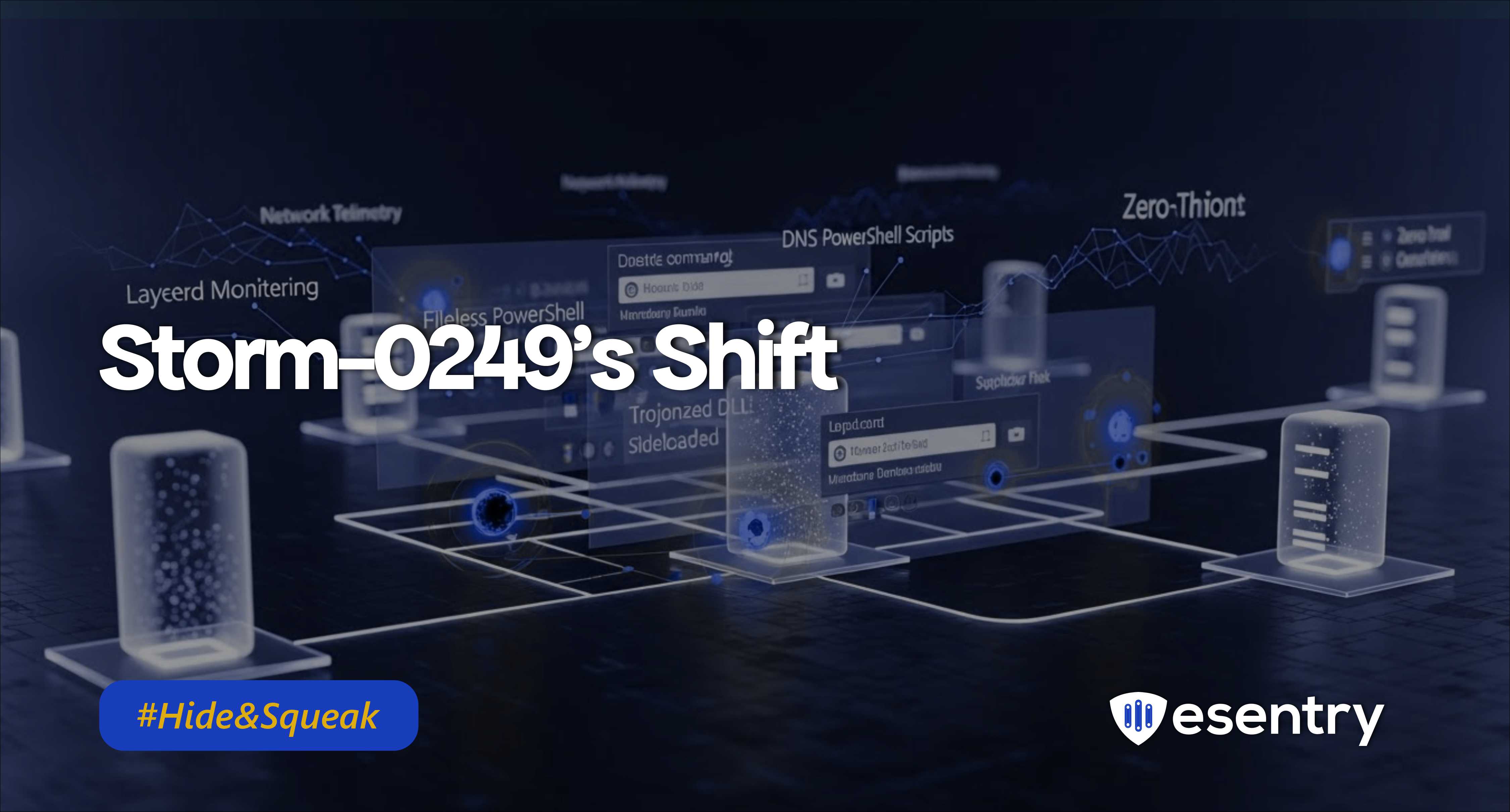
Storm‑0249, an initial access broker (IAB),has pivoted from broad phishing campaigns to highly targeted operations designed to evade detection. The group is now leveraging legitimate endpoint detection and response (EDR) processes and native Windows utilities to conduct post‑compromise activities such as reconnaissance, command‑and‑control (C2)setup, and persistence.
Storm‑0249’s evolution demonstrates how even low reputation or newly observed actors can quickly adopt advanced evasion techniques. This “newcomer innovation” dynamic lowers barriers for ransomware‑as‑a‑service affiliates and increases the likelihood of copycat adoption across the IAB ecosystem.
The most exploited gaps remain:
- Unmonitored AppData and registry hives
- Over‑reliance on perimeter and signature‑based defenses
- Unconstrained whitelisting of trusted binaries
Emerging Tactics
- ClickFix Social Engineering: Victims are tricked into running commands in the Windows Run box. These commands download spoofed installers that abuse Windows Installer’s SYSTEM privileges to gain full control.
- Trojanized DLLs: Malicious DLLs are sideloaded alongside legitimate executables, enabling stealthy code execution without triggering signature‑based alerts.
- Fileless PowerShell: Scripts are piped directly into memory via tools like curl.exe, bypassing disk‑based detection.
- Living‑off‑the‑Land Binaries (LOLBins): Legitimate system utilities are repurposed to blend in with normal IT activity.
Mitigations
- Deploy behavioural analytics to detect anomalous DLL loads.
- Implement EDR baselining to flag deviations from normal activity.
- Use DNS monitoring to identify suspicious domains less than 90 days old.
- Enforce strict LOLBin restrictions (e.g., PowerShell Constrained Language Mode).
- Aggressive segmenting of networks to limit lateral movement.
- Automate response playbooks to accelerate containment.

.jpeg)

.png)


.png)
.png)