

GitHub has confirmed a significant security incident involving unauthorized access to approximately 3,800 internal repositories after a threat actor identified as TeamPCP compromised an employee workstation using a malicious Visual Studio Code (VS Code) extension. This incident highlights the growing risk posed by software supply chain attacks targeting developer environments rather than core production infrastructure.
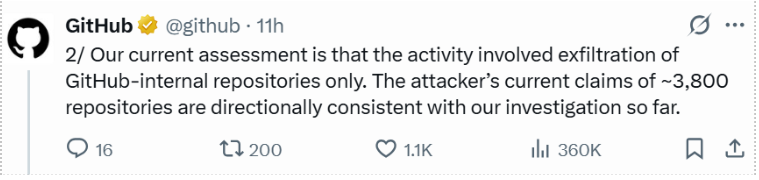
According to GitHub’s initial assessment, the breach was limited to GitHub-internal repositories, and there is currently no evidence that customer repositories, enterprise accounts, or externally stored customer data were affected. However, the scale of the repository exfiltration and the sophistication of the attack have raised serious concerns across the software development and cybersecurity communities.
What Happened
On May 20, 2026, GitHub disclosed that attackers had gained unauthorized access to internal repositories after compromising an employee device through a poisoned VS Code extension. The attack was reportedly detected and contained quickly, with GitHub removing the malicious extension, isolating the affected endpoint, and initiating incident response procedures.
Threat actor TeamPCP later claimed responsibility for the intrusion and allegedly offered approximately 3,800 stolen repositories for sale on underground forums for more than $50,000. The group reportedly stated that the operation was not ransomware-driven but instead focused on selling or leaking the stolen data.
GitHub acknowledged that the attacker’s claims regarding the number of repositories were “directionally consistent” with the company’s ongoing investigation.
How the Attack Happened
- Initial Access: Poisoned VS Code Extension
The attack originated from a malicious VS Code extension installed on a GitHub employee’s machine. Once activated, the extension reportedly executed hidden malicious code capable of interacting with the developer’s environment and existing authentication context.
VS Code extensions are particularly dangerous because they often receive broad permissions, including:
- File system access
- Network connectivity
- Terminal execution
- Workspace inspection
- Credential interaction
This effectively allows malicious extensions to behave with elevated privileges inside developer environments.
- Compromised Developer Endpoint
After infecting the employee workstation, the attackers leveraged the trusted session and existing credentials to access GitHub’s internal repositories. Rather than directly breaching GitHub’s infrastructure externally, the attackers used the developer machine as a trusted bridge into internal systems.
This technique reflects a modern software supply chain compromise model where attackers bypass hardened perimeter defenses by targeting:
- Trusted developer tools
- End-user devices
- Extension marketplaces
- Authentication tokens
- CI/CD secrets
- Repository Exfiltration
The attackers then cloned or exfiltrated internal repositories before detection occurred. GitHub stated that it immediately initiated secret rotation and forensic review after identifying the compromise.
At the time of reporting, GitHub stated there was no evidence that attackers modified production systems or inserted malicious code into public repositories.
Criminal Collaboration: TeamPCP and LAPSUS$
An additional development that significantly elevates the severity of this incident is the reported collaboration between TeamPCP and the notorious cybercriminal group LAPSUS$. According to a widely circulated dark web monitoring alert, TeamPCP and LAPSUS$ jointly advertised the sale of GitHub internal repositories allegedly stolen during the breach.
The forum post claimed:
- Access to approximately 4,000 private repositories
- Internal GitHub source code and organizational data
- A sale price ranging from $50,000 to $95,000
- Intent to leak the data publicly if no buyer emerged
- “No ransom” motivation, emphasizing monetization and exposure rather than extortion
Why the LAPSUS$ Association Matters
1. Increased Credibility of the Threat
LAPSUS$ has historically targeted major technology companies through social engineering, insider compromise, credential theft, and developer platform intrusion. The group previously impacted organizations including:
- Microsoft
- NVIDIA
- Uber
- Samsung
- Okta
Their involvement, whether operational, collaborative, or reputational adds credibility to the breach claims and increases the likelihood that the stolen data is authentic and potentially sensitive.
LAPSUS$ partnering with TeamPCP for data monetization suggests:
- Established cybercriminal marketplace relationships
- Coordinated leak operations
- Shared infrastructure or access brokers
- Expanded visibility across underground forums
This amplifies both reputational and operational risk for GitHub and any potentially affected downstream systems.
Immediate Remediation Recommendations
1. Restrict Developer Extensions
- Enforce allowlists for approved VS Code extensions
- Block unsigned or unverified extensions
- Continuously audit installed plugins
2. Harden Developer Endpoints
- Deploy Endpoint Detection & Response (EDR)
- Enable behavioral monitoring
- Implement application control policies
- Enforce device isolation capabilities
3. Rotate Credentials Immediately
Organizations should rotate:
- GitHub Personal Access Tokens (PATs)
- SSH keys
- API keys
- CI/CD secrets
- Cloud credentials
- OAuth tokens
4. Implement Least Privilege Access
Developers should only have access to repositories and systems necessary for their role.
5. Monitor for Repository Exfiltration
Security teams should review:
- Unusual Git clone activity
- Large outbound transfers
- Repository access anomalies
- New authentication patterns
As threat actors increasingly target development ecosystems, security teams must treat developer workstations and extensions as critical infrastructure rather than standard user environments.


.jpeg)
.jpeg)

.png)


.png)
.png)