

Just two days after appearing on a cybercrime leak site, Grafana has confirmed it was breached, putting one of the world’s most widely used open-source analytics platforms in the spotlight.
The incident was attributed to a compromised access token that allowed unauthorized access to Grafana Labs’ GitHub environment, resulting in the exfiltration of source code.
While Grafana has stated that no customer data or personal information was compromised, the breach underscores the growing risks associated with credential exposure and supply chain security, especially in environments hosting critical code repositories.
Timeline of Events
- May 15, 2026: Grafana listed on the “Coinbase Cartel” cybercrime leak site
- May 17, 2026: Grafana confirms breach following internal investigation
- Current Status: No public data leak observed; investigation ongoing
What Happened
- Attackers gained access via a compromised GitHub token
- Unauthorized access to Grafana’s internal code repositories
- Source code was downloaded by the threat actors
- Attackers issued a ransom demand to prevent public release of stolen data
Incident Details
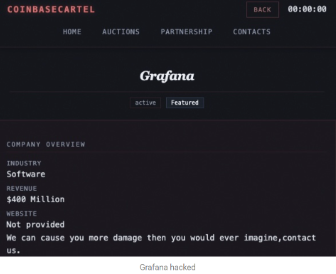
The breach was made possible through a compromised GitHub token, which granted attackers unauthorized access to Grafana’s code repositories. Tokens, often used to enable automation and integration between systems, can become highly valuable if not properly secured, monitored, or rotated. In this case, the compromised token effectively acted as a trusted identity, allowing the attackers to move undetected within Grafana’s development infrastructure.
Once access was obtained, the attackers proceeded to download source code and subsequently issued a ransom demand, threatening to release the stolen data publicly if payment was not made. Grafana has explicitly stated that it will not comply with the ransom demand and has since revoked the compromised credentials and initiated a forensic investigation.
At the time of reporting, no leaked data has appeared publicly on the group’s leak site, but the risk remains that the stolen code could be released or sold at a later stage.
Indicators Of Attacks
Relevant indicators to monitor include:
- Unauthorized or unusual access to GitHub repositories, particularly involving token-based authentication rather than user login
- Use of legacy or long-lived access tokens that have not been recently rotated
- Access to repositories from unusual geolocations or anomalous IP ranges
- Large or bulk downloads of repository content
- Unexpected API activity tied to GitHub or other development platforms
- Signs of reconnaissance or access attempts targeting CI/CD pipelines
Defensive Recommendations
- Organizations should treat this incident as a strong signal to review how access to development environments and repositories is managed.
- Particular attention should be paid to identity security, especially non-human identities such as tokens, service accounts, and API keys.
- Security teams are encouraged to implement strict controls around token usage, including enforcing short lifespans, regular rotation, and minimal privilege.
- Monitoring should be enhanced to capture anomalies in repository access, including unusual download volumes or access from unexpected locations.
- It is equally important to ensure that logging and alerting mechanisms are in place for development platforms such as GitHub. Many breaches of this nature go undetected not because of a lack of controls, but due to insufficient visibility.


.jpeg)
.jpeg)

.png)


.png)
.png)