
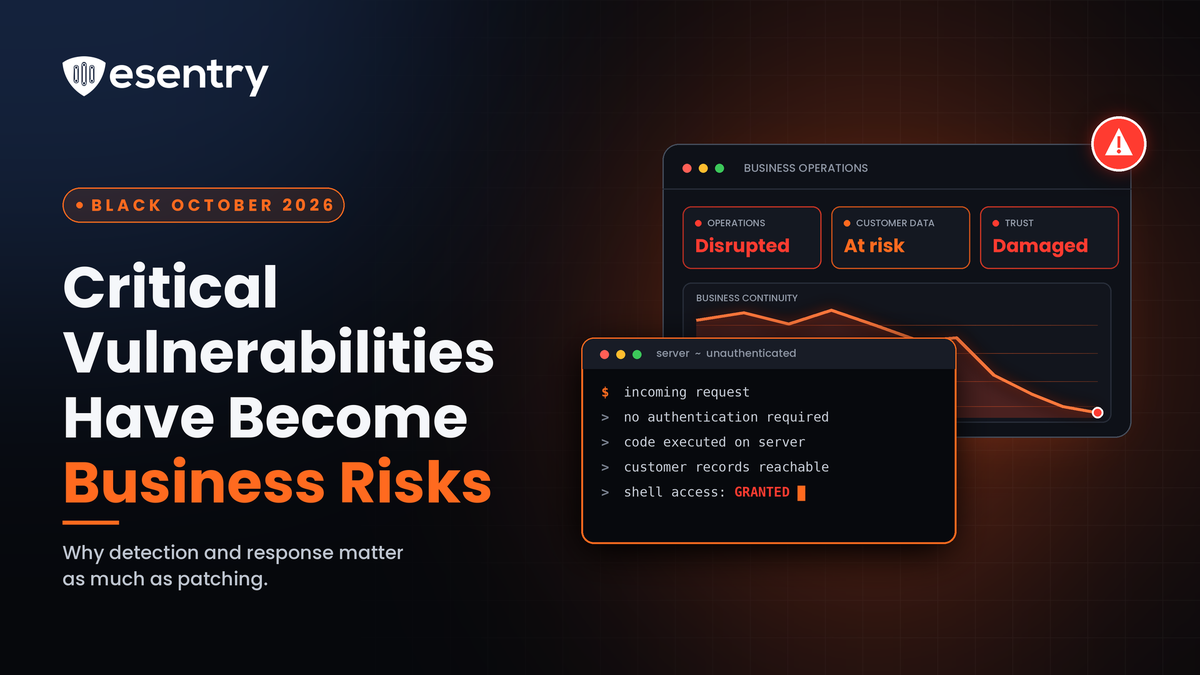
October 2026 has brought a series of serious cybersecurity disclosures involving data breaches, critical vulnerabilities, compromised software updates, exposed credentials, and attacks on widely used technology platforms. The concentration of reports over a few days has led cybersecurity professionals online to refer to the period as “Black October.”
While the name originated in social media discussions, the underlying incidents raise legitimate concerns about the security of digital infrastructure, the exposure of sensitive information, and the growing challenges organisations face in identifying and responding to cyber threats.
However, one important distinction deserves attention: the sudden wave of disclosures does not mean every attack began in October.
A wave of incidents across the technology landscape
Some of the major incidents attracting attention include:
- PHP vulnerabilities: Critical flaws in PHP prompted urgent security warnings and calls for organisations to update affected systems. Vulnerabilities in widely deployed software can expose large numbers of internet-facing applications when patches are unavailable or applied too slowly.
- Cloud and developer platform exposure: Incidents involving Railway and Zeabur raised concerns about the potential exposure of customer secrets, credentials, and environment variables used to connect applications to other services.
- Software supply chain compromise: The reported compromise of a LiteLLM software release demonstrated how malicious code introduced through a trusted distribution channel can place downstream users at risk.
- GitLab vulnerability: A critical vulnerability affecting self-managed GitLab instances highlighted the potential consequences of flaws in platforms used to manage source code and software development workflows.
- Sensitive data exposure: Reports concerning California student records and other organizations brought renewed attention to the protection of personal information, including data handled by third-party service providers.
- Certificate security concerns: The eMudhra incident raised questions about cryptographic key generation and the trust placed in digital certificates used to authenticate websites.
The bigger concern: attacks may begin long before disclosure
One of the most important lessons from Black October is the gap between the start of an attack, its discovery, and its public disclosure.
An organisation may announce a breach in October even when unauthorised access occurred months earlier. During that period, attackers may have had opportunities to access information, collect credentials, move through connected systems, or maintain access without immediately disrupting normal operations.
This creates a difficult question for security teams: How long could an attacker remain in an environment before anyone recognises the activity?
Preventing every intrusion is an important objective, but it is not the only measure of security effectiveness. Organisations also need the visibility to detect suspicious activity, investigate unusual behaviour and contain incidents before the damage spreads.
Effective security operations therefore depend on more than the number of alerts generated by monitoring tools. They require meaningful detection rules, timely investigation, reliable logging and a clear understanding of what constitutes normal activity across endpoints, identities, networks and cloud services.
The supply chain problem: trust can become an attack path
Another recurring theme is the risk created by third-party services and software dependencies.
Organisations increasingly rely on cloud platforms, open-source libraries, software vendors, managed service providers and external development tools. These relationships improve efficiency, but they also expand the number of systems and identities that must be secured.
This means that reviewing an organisation's security posture cannot stop at its own network perimeter. Trust in a vendor should be supported by verification, monitoring and clearly defined security responsibilities.
Artificial intelligence is changing the security equation
The discussion surrounding Black October has also raised questions about the role of artificial intelligence in cybersecurity.
AI models helped researchers discover the PHP2Shell vulnerabilities. A separate report has described attackers using AI-assisted tooling to automate reconnaissance and exploit weaknesses across multiple organisations.
These developments demonstrate that AI can support defensive research while also potentially helping attackers work faster. However, it would be inaccurate to attribute every incident in this disclosure wave to AI or to assume that autonomous AI systems were responsible for all the attacks.
The more immediate concern is the speed at which vulnerabilities can be identified, exploitation can be automated, and mistakes in existing security controls can be turned into opportunities.
What organisations should prioritize
BlackOctober offers practical lessons for organisations seeking to strengthen their security posture. Organizations should take the following steps to reduce their exposure:
- Patch vulnerabilities: Identify affected systems and apply security updates, prioritising critical vulnerabilities and flaws known to be actively exploited.
- Secure credentials: Review API keys, passwords, access tokens, and cloud secrets. Revoke or rotate exposed credentials and investigate suspicious activity.
- Monitor security logs: Check for unusual logins, unauthorised account changes, suspicious processes, and unexpected network connections.
- Review third-party risks: Assess software dependencies, vendors, and cloud services for reported compromises that could affect your environment.
- Investigate potential compromise: If exposure is suspected, review relevant logs, identify affected systems, contain unauthorised access, and preserve evidence for further investigation.
- Strengthen incident response: Ensure security teams can quickly detect, contain and recover from incidents.
- Monitor threat intelligence: Follow trusted security advisories and vulnerability disclosures to identify emerging threats and take timely action.
Beyond the Headlines
The significance of Black October is not simply the number of cybersecurity incidents disclosed within a short period. It is what these incidents reveal about the interconnected nature of modern technology.
A weakness in one software component, a compromised credential, or an insecurethird-party integration can create consequences far beyond the original point of failure. Meanwhile, delayed detection can give attackers time to expand their access before an organisation understands the full extent of the incident.
The lesson from Black October is clear: cybersecurity resilience depends not only on preventing attacks, but also on reducing exposure, detecting compromise early, and responding before a single weakness becomes a wider incident.