Multiple vulnerabilities have been identified in Node.js that could allow attackers to execute arbitrary code, cause denial of service, disclose sensitive information or bypass security restrictions.
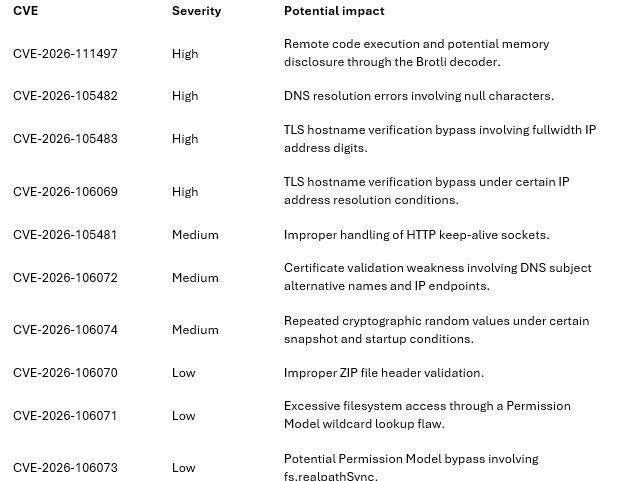
The most notable issue, CVE-2026-111497 (Node2Shell), affects the Brotli decoder and could enable remote code execution when vulnerable applications process specially crafted, attacker-controlled compressed data. Security researchers have demonstrated code execution against an official Node.js build.
The October 2026 security update addresses additional flaws affecting DNS resolution, TLS certificate validation, socket handling, cryptographic randomness and the Node.js Permission Model. Organisations should prioritise patching to reduce the risk of vulnerability exploitation across their applications and infrastructure.
Vulnerability Details
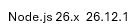
Affected Versions
The following Node.js release lines have fixes available:

Potential Impact
Successful exploitation could lead to:
- Remote code execution: Attackers may execute code within a vulnerable application process, potentially enabling further system compromise.
- Information disclosure: Memory-related flaws may expose sensitive process data.
- Service disruption: Malformed input may cause application crashes or denial of service.
- Security control bypass: DNS, TLS and filesystem permission weaknesses could undermine application security.
Recommendation
Organisations should:
- Apply security updates: Upgrade affected Node.js installations to the appropriate fixed versions.
- Identify vulnerable systems: Review production servers, containers, development environments and CI/CD pipelines for affected runtime versions.
- Review Brotli processing: Identify applications that process untrusted Brotli-compressed data, including services using node:zlib and affected HTTP request or response handling components.
- Update container images: Rebuild and redeploy containers using patched Node.js base images, verifying the runtime version in production.
- Review security controls: Validate TLS certificate checks, filesystem permissions and application access restrictions.
- Monitor suspicious activity: Investigate unusual process execution, application crashes, unexpected outbound connections and other potential indicators of exploitation.
Where patching cannot be completed immediately, organisations may consider restricting Brotli-encoded traffic at appropriate gateways where operationally feasible. Such restrictions are temporary risk-reduction measures and do not replace patching.
Timely patching and continuous vulnerability monitoring remain essential to reducing exploitation risks and protecting business-critical services.